
- Cet évènement est passé.
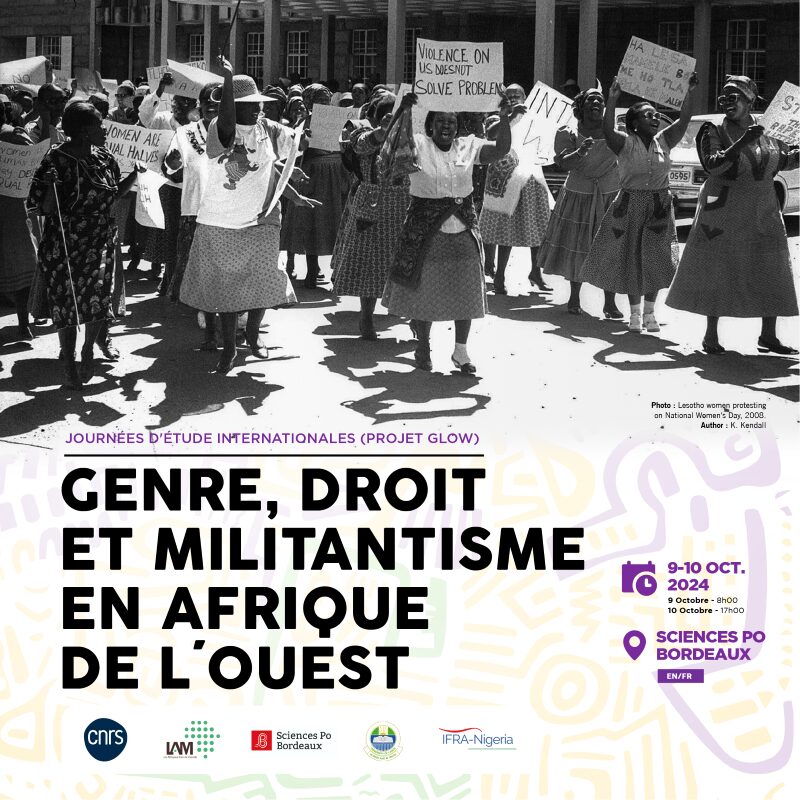
Journées d’étude internationales « Genre, droit et militantisme en Afrique de l’Ouest » (projet GLOW)
9 octobre 2024 / 8h00 – 10 octobre 2024 / 17h00
Participation in person only, registration is compulsory before October 8th 2024, 5pm (GMT+2)
Participation en présentiel uniquement, inscription obligatoire avant le 8 octobre , 17h (GMT+2)
LOCATION/ LIEU: Sciences Po Bordeaux, 11 Allée Ausone, 33600 Pessac, France
Simultaneous English/French and French/English translation for both days will be provided by Anne Geurts and Lucile Rozé with technical assistance from Triaxe.
La traduction simultanée anglais/français et français/anglais des deux journées est assurée par Anne Geurts et Lucile Rozé avec l’assistance technique de Triaxe.
International Workshop
Gender, Law and Political Activism in West Africa
GLOW Research Project
For decades, West African women have been mobilizing for legal recognition of gender equality, yet the intersection between women’s mobilizations and the law remains largely unexplored. This research project aims to bridge this gap by conducting studies that explore the intersection of gender, activism, and law in West Africa from the 20th to the 21st century. By examining the history of women’s mobilisations for legal rights, the project seeks to provide a fresh perspective on the political and social history of the region during both the colonial and post-colonial periods. It aims to offer new insights into the legal construction of political and social inequalities over time.
This project adopts a multidisciplinary approach that aims to bring together researchers from a variety of fields, including historians, sociologists, anthropologists, political scientists and legal experts. By doing so, this program aims to overcome disciplinary and methodological barriers that hinder the historical analysis of the relationship between law and mobilization, as well as the origins of certain legislative debates that have been ongoing for decades. GLOW also promotes multiscalar approaches, analysing both local mobilisations and the impact of international standards on mobilisations and legislations. In addition, the collaboration between anglophone-speaking and francophone-speaking researchers is central to the project, as it highlights the differences and similarities in legal heritage and moves beyond linguistic and imperial boundaries.
[FRANCAIS]
Les femmes d’Afrique de l’Ouest occidentale se mobilisent depuis plusieurs décennies pour la reconnaissance juridique de l’égalité des sexes. Toutefois, le croisement entre mobilisations féminines et droit reste encore peu exploré. Ce projet de recherche collectif vise à combler ces lacunes à travers des analyses qui croisent les rapports entre genre, droit et mobilisations en Afrique de l’Ouest aux XXe et XXIe siècles. Il s’agit ainsi de renouveler l’histoire politique et sociale de la région à l’époque coloniale et postcoloniale en proposant des éléments de compréhension des inégalités socio-politiques et de leurs constructions juridiques dans le temps.
Avec une approche multidisciplinaire, qui ambitionne de mettre en dialogue historien.ne.s, sociologues, anthropologues, politistes et juristes, ce programme veut dépasser un cloisonnement disciplinaire et méthodologique qui fait obstacle à un travail d’historicisation des rapports entre droit et mobilisations et à la reconstruction de la genèse de certains débats législatifs, menés pourtant depuis plusieurs décennies. Ce projet privilégie aussi des approches multiscalaires, qui analysent à la fois des mobilisations locales mais aussi l’impact des normes internationales sur les mobilisations et sur les législations. Par ailleurs, le dialogue entre Afrique anglophone et francophone est central dans le projet, à la fois pour souligner les similitudes et différences en termes d’héritages juridiques, mais aussi pour sortir des frontières impériales et linguistiques et ainsi pouvoir tracer les éventuelles continuités dans les mobilisations sociales visant à réformer le droit.
Program / Programme
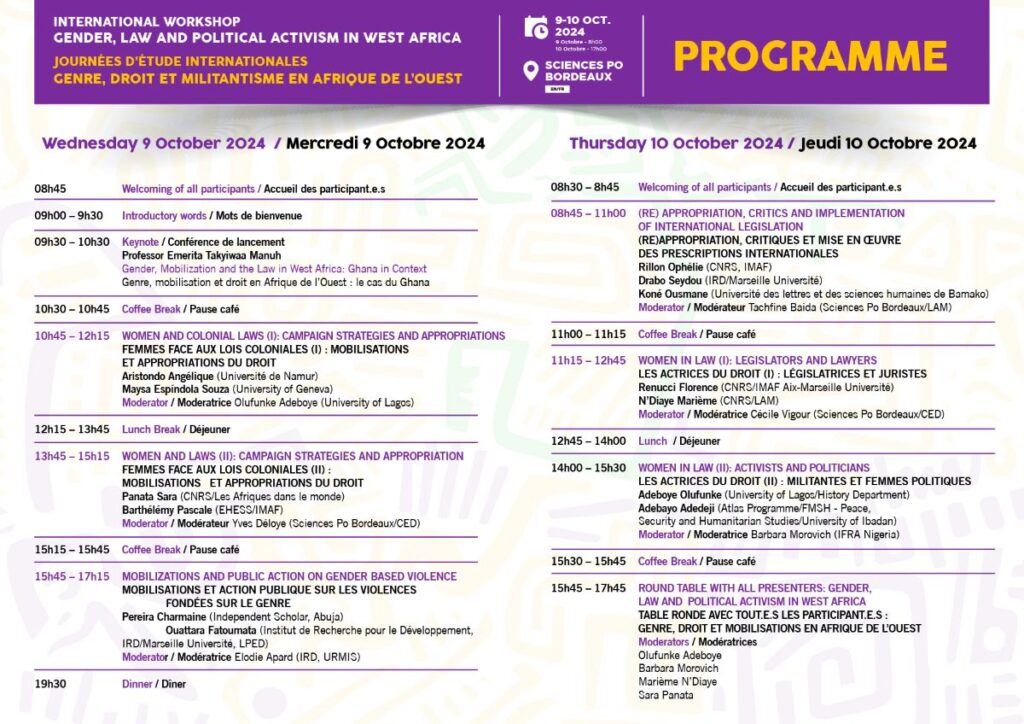
Wednesday 9 October 2024/Mercredi 9 octobre 2024
- 8h45 Welcoming of all participants/Accueil des participant.e.s
- 9h00 – 9h30 Introductory words / Mots de bienvenue
- 9h30 – 10h30 Keynote/Conférence de lancement
Professor Emerita Takyiwaa Manuh,
Gender, Mobilization and the Law in West Africa: Ghana in Context.
Genre, mobilisation et droit en Afrique de l’Ouest : le cas du Ghana.
- 10h30 – 10h45 Coffee Break / Pause café
- 10h45 – 12h15
Women and Colonial Laws: Campaign Strategies and Appropriations (I)
Femmes face à aux lois coloniales: Mobilisations et appropriations du droit (I)
– Aristondo Angelique (Université de Namur)
(Non)-Judiciarisation of sexual violence in Guinea and Senegal during the colonial period: two case studies (1910-1933)
(Non)-Judiciarisation des violences sexuelles en Guinée et au Sénégal à la période coloniale : deux études de cas croisées (1910-1933)
– Maysa Espíndola Souza (University of Geneva)
Labour and gender inequities under Portuguese Colonial Rule: Indigenous women in Portuguese Guinea (1917-1961)
Inégalités de travail et de genre sous la domination coloniale portugaise : les femmes de Guinée portugaise (1917-1961)
Moderator/Moderatrice : Olufunke Adeboye (University of Lagos)
- 12h15 – 13h45 Lunch Break/Déjeuner (La Passerelle)
- 13h45 – 15h15
Women’s Encounter with Colonial Laws: Campaign Strategies and Appropriations (II)
Femmes face à aux lois coloniales: Mobilisations et appropriations du droit (II)
– Panata Sara (CNRS/Les Afriques dans le monde)
Creating Women Voters. Discourses, laws and mobilizations around universal suffrage in Gold Coast and Nigeria (1928-1960s)
La fabrique des électrices. Discours, lois et mobilisations pour le suffrage universel en Gold Coast et au Nigeria (1928-1960s)
– Barthélémy Pascale (EHESS/IMAF)
Mothers of ‘two children alive or who died for France’ seized the right to vote. Voting and elections in French Sudan (May-June 1951)
S’emparer de la loi ? L’accès au suffrage des mères de « deux enfants vivants ou morts pour la France » au Soudan français (mai-juin 1951)
Moderator/Modérateur :Yves Déloye (Sciences Po Bordeaux/CED)
- 15h15 – 15h45 Coffee Break/Pause café
- 15h45 – 17h15
Mobilizations and public action on gender-based violence
Mobilisations et action publique sur les violences fondées sur le genre
– Pereira Charmaine (Independent Scholar, Abuja)
Nigeria’s Violence Against Persons (Prohibition) Act, 2015: 14 Years of Struggle (2001-2015)
La loi nigériane de 2015 sur l’interdiction de la violence à l’égard des personnes : 14 ans de combats (2001-2015)
– Ouattara Fatoumata (Institut de Recherche pour le Développement, Marseille Université, LPED),
Campaigning on violence against women in Togo?
Se mobiliser pour les violences faites aux femmes au Togo?
Moderator/Modératrice : Elodie Apard (IRD, URMIS)
Thursday 10 October 2024 / Jeudi 10 octobre 2024
- 8h30 Welcoming of all participants/Accueil des participant.e.s
- 8h45 – 11h00
(Re)appropriation, critics and implementation of international legislation
(Re)appropriation, critiques et mise en œuvre des prescriptions internationales
– Rillon Ophélie (CNRS, IMAF)
Protecting the rights of women in the teaching profession? Trade union activism and women workers’ rights in Burkina Faso
Défendre les droits des enseignantes ? Mobilisations syndicales et droits des travailleuses au Burkina-Faso
– Drabo Seydou (Institut de Recherche pour le Développement, Marseille Université),
Campaigning for Sexual and Reproductive Women’s Rights: Maputo Protocol and Women’s Struggle in Burkina Faso
Mobilisation pour les Droits Sexuels et Reproductifs des Femmes : Le Protocole de Maputo et l’Engagement Militant féminin au Burkina Faso
– Koné Ousmane (Université des lettres et des sciences humaines de Bamako),
Les difficultés des organisations féminines à faire adopter une loi contre l’excision au Mali : les limites de l’approche legale.
The difficulties of women’s organizations to pass a law against excision in Mali : the limits of the legal approaches.
Moderator/Modérateur : Tachfine Baida (Sciences Po Bordeaux/LAM)
- 11h00 – 11h15 Coffee Break/Pause café
- 11h15 – 12h45
Women in Law I: legislators and lawyers (I)
Les actrice du droit I: législatrices et juristes
– Renucci Florence (CNRS/IMAF Aix-Marseille Université)
Women legislators. Legal activism in Côte d’Ivoire from the 1930s to the present day
Les législatrices. Militantisme juridique en Côte d’Ivoire des années 1930 à nos jours
– N’Diaye Marième (CNRS/LAM)
Expertise in the name of efficiency? Women lawyers mobilisations in the fight to legalize abortion in Senegal
Privilégier l’expertise au nom de l’efficacité ? L’exemple des femmes juristes dans la lutte pour la légalisation de l’avortement au Sénégal
Moderator/Modératrice : Cécile Vigour (Sciences Po Bordeaux/CED)
12h45 – 14h Lunch / Repas fourni par le « Programme Alimentation Santé et Solidarité », Espace Social et d’Animation Alain Coudert, Pessac.
- 14h – 15h30
Women in Law: activists and politicians (II)
Les actrices du droit : militantes et femmes politiques (II)
– Adeboye Olufunke (University of Lagos/History Department), From Wuraola Esan to Aisha Yesufu: The Travails of Female Political Activists in Post-Colonial Nigeria
De Wuraola Esan à Aisha Yesufu : Les difficultés des militantes politiques au Nigeria postcolonial
– Adebayo Adedeji (Atlas Programme/FMSH – Peace, Security and Humanitarian Studies/University of Ibadan),
Fighting against gender-based violence: Life stories of women activists from southwest Nigeria
Lutter contre la violence fondée sur le genre : Histoires de vie de femmes activistes du sud-ouest du Nigeria
Moderator/Moderatrice: Barbara Morovich (IFRA Nigeria)
- 15h30 – 15h45 Coffee Break/Pause café
- 15h45 – 17h45
Round table with all presenters: Gender, Law and Political Activism in West Africa
Table ronde avec tout.e.s les participantes : Genre, Droit et Mobilisations en Afrique de l’Ouest
Moderators/Modératrices : Olufunke Adeboye, Barbara Morovich, Marième N’Diaye, Sara Panata
Organising Team/ Equipe organisatrice
Olufunke Adeboye (University of Lagos) : oadeboye @ unilag.edu.ng
Barbara Morovich (IFRA Nigeria): director @ ifra-nigeria.org
Marième N’Diaye (CNRS-Les Afriques dans le Monde): m.ndiaye @ sciencespobordeaux.fr
Sara Panata (CNRS-Les Afriques dans le Monde): sara.panata @ cnrs.fr
Informations pratiques
- Participation in person only, registration is compulsory before October 8th 2024, 5pm (GMT+2)
Participation en présentiel uniquement, inscription obligatoire avant le 8 octobre , 17h (GMT+2) - LOCATION/ LIEU: Sciences Po Bordeaux, 11 Allée Ausone, 33600 Pessac, France
- Simultaneous English/French and French/English translation for both days will be provided by Anne Geurts and Lucile Rozé with technical assistance from Triaxe.
- La traduction simultanée anglais/français et français/anglais des deux journées est assurée par Anne Geurts et Lucile Rozé avec l’assistance technique de Triaxe.
